
KCO: Where did your musical journey begin?
KCO: What led to your being a conductor?
KCO: When did you move to this area?
KCO: What do you want to say about the March program?
KCO: Where did your musical journey begin?
Tigran Arakelyan: I was born in Armenia, and, started music in Armenia, when I was 9 years old. My parents both played music, not professionally, but they both played music. My grandmother was a music teacher.
My music started because I was experiencing a chronic breathing issue, and a lot of coughing. My parents didn’t really know what was going on. I guess asthma or whatever it might be. I went to many places, including Yevpatoria, which is in Crimea and Ukraine. There was a children’s clinic there that incorporated Western and Eastern medicine and tried to find alternative ways to help kids with all kinds of different health-related concerns.
I tried all kinds of things when we were back in Armenia. My parents were trying to get some other advice, and one of the homeopathic doctors suggested I should do some kind of wind instrument, because it’ll be helpful with lungs and breathing.
The person suggested Zurna, which is this double reed instrument. It’s a folk instrument. It’s very loud, and my parents said absolutely not. We do not want that in the house!
So, my parents picked the flute for me. That’s how I started. I played for a couple of years in Armenia, then moved to LA when I was 11. I continued playing in the 6th grade band. So yeah, that’s where the music journey started.
KCO: It was more like physiotherapy than music?
Tigran Arakelyan: Basically, yes.
KCO: Did you enjoy it?
Tigran Arakelyan: Yes, right away. If I didn’t feel motivated enough, my mom would just sit down and say, “play for me, I want to hear what your progress is, and what you’re learning.” She was consistent that way, so that was very helpful.
Even though it was after the Soviet Union, and Armenia was part of the Soviet Union, it was still a Soviet-type music school. You had to take private lessons, solfège, music theory, and history, and all that. It was great.
And then I came to the States, and we had a bit of a hard time finding private lessons outside of the school. Public schools provide a lot of education; I hope it continues. There’s a lot of arts and music in public schools. But it was great to come to Glendale, California and join the elementary school band.
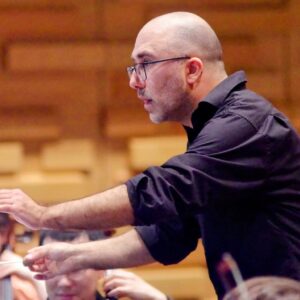
Before finding other community places to be a part of, we found this Armenian music school, which was open to anyone. It was run by Armenians and Lark Musical Society. I went there.
I started there when I was maybe 12 or 13 years old. It was a year or so after we moved to the LA area. I learned a lot. It was very similar to my previous experience where you take very affordable private lessons. You have Chamber music on Saturdays. You have music theory and history classes. I met so many friends there, people that I really enjoyed being around. It was a great program.
KCO: What led to your being a conductor?
KCO: You had first to pursue a music education beyond the public school. Later, it must reach a point where you think, “I’m going be a conductor.”
Tigran Arakelyan: It was a lot of different things. First, I was mostly in the classical world, and studying music, primarily with people who had a classical music background. I really was fortunate to have a teacher, Laura Osborn, at this Armenian music school. She went to USC for classical flute, I think. She then went to New England Conservatory for some improvisation program. She was interested in all kinds of genres, not just classical music.
My parents always listened to all kinds of different music, so I was also interested in jazz and other genres. Studying with Laura, I would always go with questions. I found this jazz flute player, Herbie Mann, or Hubert Laws or other. I asked about Ian Anderson from Jethro Tull. I would find music, and she’d say “oh, it’s great you found this!”
I found Nestor Torres, this Latin jazz flute player. I would find these recordings and be fascinated by them. She was fantastic. I was able to work on projects that she wanted to work on, but she was also fantastic about what I would find. She would say, “oh, that’s great. You should listen and see if you could transcribe it. Or, listen and see if you can play it by ear.” She was encouraging and that led me to be interested in all kinds of different genres.
When I was finishing high school, I just didn’t know if I even wanted to be a flutist. I didn’t know if I wanted to have a career playing in an orchestra or even being a classical flutist. I really wanted to do all kinds of other genres, and so I did that for a bit.
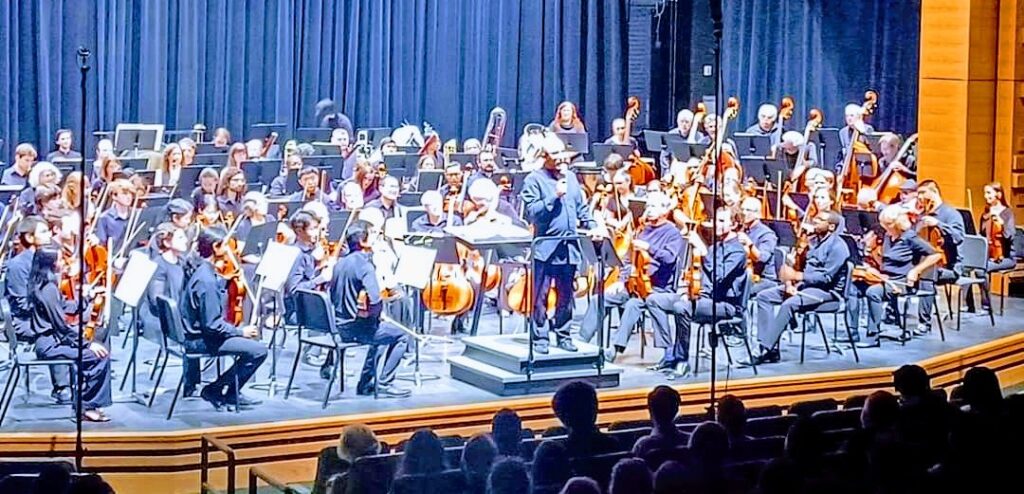
I did 5 years in college for my undergrad. When I was 22, one of my friends suggested that I take a conducting class. He said something like, “You conduct, you learn a little bit, and you play. Everyone plays, and everyone conducts. It’s easy. You should take it.”
I wasn’t sure. I didn’t know conducting. But I did take it, and it was really cool. I was actually fascinated by conducting, and that’s where it took off.
I started my first orchestra, and there’s still a Seattle Weekly review of our first concert. We played at a bar, and we played in other places. But it’s kind of funny, because it was my first concert ever, and I put this orchestra together. The concert was reviewed in the Seattle Weekly. The program was Beethoven’s First symphony, Paul Hindemith – Kammermusik Nr. 1, and this piece by Arshak Andriasov, an Armenian-American composer who lives in New York. The piece is called Torch 1. The concert was great. That’s where my conducting career took off.
KCO: Wow! That’s a very diverse program.
KCO: When did you move to this area?
Tigran Arakelyan: When I graduated high school, I came up here because I was interested in all kinds of different genres, and so I was looking for a program that fits that interest.
I went to Cornish for a year, and I just really didn’t like the program as much as I hoped. As open as it was, it’s not something I found interesting. I wanted some more structure than I was getting, and missing, in some ways, the orchestral playing, which I didn’t get at Cornish. I did that for a year in 2005.
Then I went back to LA and went to Cal State Long Beach, which has a good program for music, and it continues to be good. I got into that program when I was applying to colleges to study with Dr. John Barcellona. He was a really great teacher to have the opportunity to study with, so I did that for a few years. This is when I expanded to being 5 years in college, because I did a couple of years at Cal State Long Beach.
Then I went back to Cornish to finish things up and start conducting again. So, it was like, Long Beach with, Cornish on either side.
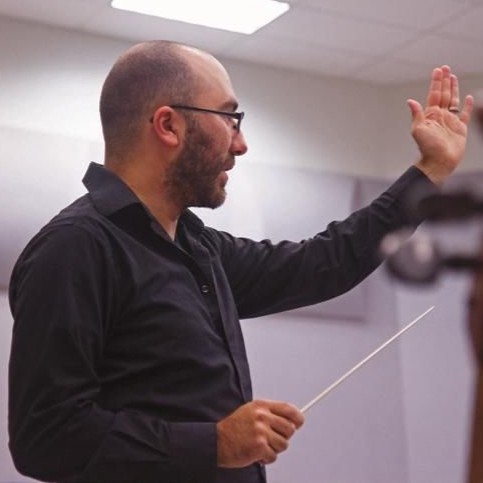
I went back to California after I was done and did my master’s. Then, in 2013, I was invited by Ludovic Morlot to do the doctoral program at the University of Washington. That’s when I came back to Washington.
My time in Seattle has been spread over three different times: One year, when I first started undergrad, the final year of undergrad, and then doctoral degree at UW in 2013. I’ve been here since 2013.
KCO: What do you want to say about the March program?
- Hebrides Overture – Mendelssohn
- Prelude from Hansel and Gretel – Humperdinck
- Afternoon of a Faun – Debussy
- Capriccio Espagnol – Rimsky-Korsakov
- Capriccio Italien – Tchaikovsky
Tigran Arakelyan: It’s entitled “Escapades,” so it’s like an adventure. I don’t always like to do themes, but I wanted to have a bit of a theme this time. I don’t have to dive too deep into history, but the Mendelssohn — The Hebrides Overture is the only piece I ever conducted from memory, which I did for my master’s. It’s about Fingal’s Cave, exploring Scotland.
Hansel and Gretel, that’s very interesting, because I play a lot of music for my kids at home. Sometimes, it is just kind of in the background, they might not pay attention, but sometimes they might make a remark, “wow, this is cool.” I played the whole Escapades program for them, and Hansel and Gretel is the one they connected with. And it’s not surprising, because I think Humperdinck does a great job. It is a fairy tale, it is meant for kids. So, in some ways, it’s kind of funny that they enjoyed listening to that, as opposed to any of the other pieces. Maybe it says a lot about the composer, of how he was able to turn this fairy tale into music that is interesting for kids.
KCO: The Capriccios are super fun, I think.
Tigran Arakelyan: Those are great. I’ve programmed those together at one point with a different orchestra. It’s like these Russian composers exploring music of Spain and Italy. It’s cool to do that. Also, the other thing I wanted to say about the program overall, is that it’s really like a concerto for orchestra if you look at the whole program. Many of the players get some important moments.
And then the Debussy, it’s the first piece I conducted when I started my doctoral degree at the University of Washington, so that’s an interesting connection for me. Also, it is just an interesting piece. When I was a junior in California, I played second flute for this piece, so I didn’t get a chance to play that flute solo, but it was great. I remember sitting next to the person that was playing, and I was like, wow, this is so awesome.
KCO: Wow, that so interesting because during our first read-through with you, Doug (Gallatin) was the second flute that night. It wasn’t his part. He steps up, plays it and he crushes it.
Tigran Arakelyan: Yeah, it was great. I was really impressed, and he was so humble. He came to me before the rehearsal, and he asked if he should play the first part even though he was the sub, and then, he just rocked it. I said, “you’re amazing. You sounded great”.
KCO: Thank you for taking the time to do this.
Thanks to Tigran for the interview on January 15, 2026.
by Francis X. Langlois – tuba player in the KCO
