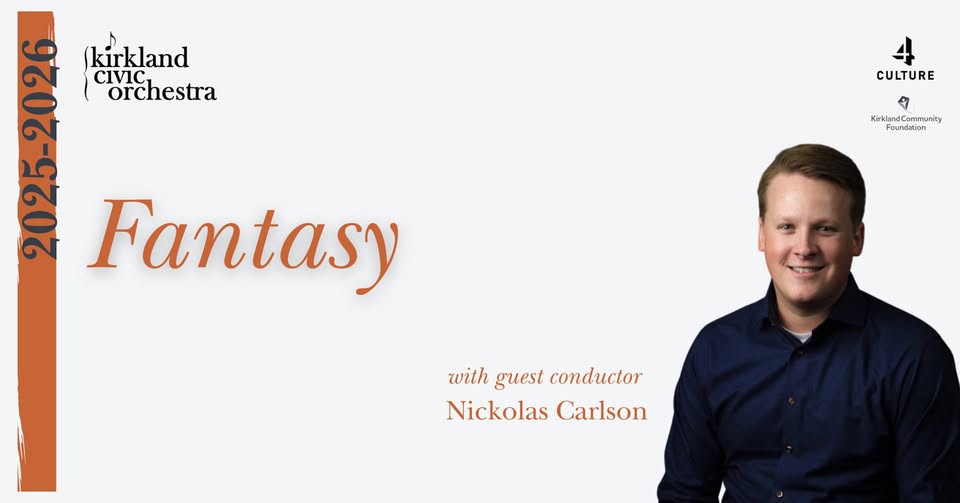
KCO: Where did your musical journey start?
KCO: What led you to extend your music education and eventually become a conductor?
KCO: What do you want to say about the November program?
KCO: Where did your musical journey start?
Nickolas Carlson: I grew up on a farm outside of a small town in rural Kansas called Lindsborg, and that was also where my musical journey began. The town had a population of maybe 3,500. The community and the public schools all had wonderful support for the arts. The music programs in the schools were wonderful, and all my teachers growing up, specifically the music teachers, were so knowledgeable and so encouraging. They really gave me a good start to my musical career.
That community, back in the 1800s, started doing the Messiah every single year. It is the longest-running continuous annual performance of the Messiah in the United States. I was able to join that orchestra when I was in high school, and I played in the second violin section. I played all the way through graduate school in that ensemble with the Oratorio Society. They did the Messiah every Palm Sunday and every Easter, but they also did the St. Matthews Passion, Bach’s St. Matthew Passion, every Good Friday. Once I got to college, I started playing in the orchestra for the St. Matthew Passion as well.
Having those experiences with this large group of people, all performing this music together, from all different walks of life, really solidified for me the idea that music helps us form community. It helps us live in a community together. I even completed my undergraduate degree in my hometown. I tried to go off to a state school, but I wasn’t quite ready to leave home yet. So, I went back to my hometown to do my undergraduate studies.
KCO: And what was the college?
Nickolas Carlson: The college was Bethany College.
KCO: What led you to extend your music education and eventually become a conductor?
Nickolas Carlson: I have always loved orchestra. I was never a great violin player. I was a decent clarinet player, but my heart really wasn’t in it. So, when I was studying organ performance in undergrad, I decided that I wanted to go on to study organ performance for graduate school and to become the keyboard player for a symphony orchestra.
The last year of my undergraduate degree, I got to study abroad in Sweden. I was ahead in my coursework enough to spend the entire semester only focusing on folk music. While my focus was on folk music, I still had a senior recital to prepare for when I returned. I was trying to practice the organ. The organ at this school had not been played in many years and was not in good repair. And so instead of practicing the organ, I often fell to studying scores.
They had a large music library with a lot of scores. I would grab a score, I would go to the house that I was living in, and I would just follow along with scores and listen to recordings. I had always had sort of an interest on the side in conducting. One of the older women who sang in the Messiah Chorus where I grew up used to joke with me about coming back and conducting that Oratorio Society when I grew up. I had told her when I was in middle school that that was going to be my career. I was going to be the director of that Oratorio Society when I grew up. I don’t remember that, but she reminds me of it every time she sees me.
I had always had this kind of interest on the side with conducting, and that time in Scandinavia, studying all these scores solidified that for me. I had taken all of the conducting classes I could in undergrad. I loved it. But the focus on score study solidified it for me when I was in Sweden.
I came back to finish my undergraduate degree, and I told my organ teacher, “I’ve changed my mind, and I don’t want to go to graduate school for organ. I want to go for conducting.” She was one of the greatest teachers I’ve ever had in my life, and she said, okay, well, we’ve still got to do your senior recital, so we’re going to finish that up. But why don’t you prepare a conducting recital, too?
It was not part of my coursework, but I did all the work to prepare this conducting recital. I got a small group of musicians together, and we did a conducting recital. Then, I did a very last-minute audition for graduate school because I had decided late, and got into Wichita State University. It was not my first choice. It wasn’t even on my radar, but it was the school that was still open for applications, and it worked out really well.
I went to Wichita State the next fall. I did a dual track of study. I was getting a Bachelor of Music Education at the same time I was getting my Master of Music in conducting. At the time, everyone was telling me that if you really want to get into conducting, you either have to go the opera route and become an opera pianist that eventually becomes a conductor. Or you need to go the public-school route and teach orchestra in schools. That’s going to be how you break into the conducting world.
I had planned to spend 3 years in graduate school, because I was doing both degrees at the same time. I got to my third year, and my conducting teacher gave me the opera that semester. He had a trip when this performance was happening. He asked if I would like to conduct the production? And so I did, and I did all the coursework for the music ed degree, except student teaching. So, I did not get the Bachelor of Music Education, but the opportunity to conduct the opera production was too good to pass up.
KCO: How did that translate into conducting as a profession? You are not teaching at present, but you are conducting.
Nickolas Carlson: Yeah, I got lucky, I guess. After graduate school, I decided I wanted to move to a different part of the country, either the east or west coast, or down south.
I met a friend in graduate school who grew up here in Washington, who was moving back home after graduate school. I thought to myself that I really don’t think I’m going to like the East Coast. It’s just the population density is just a little bit too much for me. There’s a built-in support system moving with this friend back to the West Coast. Seattle sounds beautiful, so we moved out to Seattle.
I was living in West Seattle. She grew up in Lacey and went to St. Martin’s University down here in Lacey. She introduced me to her teacher from her undergraduate degree. I met him and started working at the college.
I found out that the community orchestra down here, the Olympia Chamber Orchestra, was also looking for a conductor, because their conductor was retiring, and applied for that job, and I got lucky. Right out of grad school, I moved here, and this orchestra is looking for a conductor, and it’s kind of the perfect inroad. It’s a community orchestra, and they just want somebody that’s going to help them continue into the future. At that time, they were not paying the conductor. It was an all-volunteer gig, and I did that for a few years. Then it was obvious that there was this desire to continue to build, and I said, at some point, I’m going to have to leave. And, you’re going to have be lucky enough to find another conductor just out of grad school who’s going to do it for free. So, we started the process, starting with a very low payment for the conductor, just to get them used to the idea. And now, I’ve been with them for 8 years now.
KCO: That’s awesome. It’s a great story of both parties being willing to take a chance.
KCO: What do you want to say about the November program?
- Overture to Der Freischütz – Weber
- Overture to Der Vampyr – Lindpaintner
- Ma Mere L’Oye (Mother Goose Suite) – Ravel
- Overture to Orpheus in the Underworld – Offenbach
- Symphonie Fantastique – Movements IV. and V. – Berlioz
Nickolas Carlson: I am so excited about this program. There’s are several pieces that I have been wanting to do for a while. The Weber, Overture to Der Freischütz, is absolutely one of my favorite pieces. It just has this perfect atmosphere, for this time of year. I went back and forth on how much I wanted to tie this program to the season. But the more I thought about it, the more I whittled down my repertoire list, then found something, and then expanded on that, I just realized that I really love this time of year. And I think there’s a lot of wonderfully descriptive music that’s written about this time of year–this autumnal changing of the seasons with Halloween-ish kind of vibes.
When I auditioned for the Olympia Chamber Orchestra, I had the repertoire that I chose. I decided a few years later that I was going to try to include one of the pieces from that program on every audition that I did for an orchestra in the future. So, for this concert, that ended up being the Ravel Mother Goose Suite. The other piece it could have been was Beethoven’s First Symphony, which is one of my absolute favorite pieces. For an orchestra that’s larger, like the Kirkland Civic Orchestra, I felt like something like the Ravel might be a better showcase for the group than something like the Beethoven, which is a bit smaller in its instrumentation. You take the idea of Mother Goose and all these fairy tales and stories, and then it leans right into the fantasy of the autumn season.
I have had such a great time working with the orchestra. I think that we’ve made a lot of progress together. You know that the Berlioz Symphony Fantastique is on a lot of people’s bucket lists. It was surely on mine, and someday I’ll do the whole thing. It is a tough piece, and particularly for a community orchestra to go on this journey with me, of learning this piece, and doing all of this hard work that it takes to get it done. I’m so thankful to the group for doing that work with me and being willing to go along with it.
The Lindpaintner overture is something that’s a bit strange, you know? The subject matter has that same feel. It’s based on the story of a vampire. It really isn’t that dark a piece, musically. It actually sounds pretty happy. If you had not told me what the title was, I would have never guessed it was called The Vampire.
One of my passions with orchestras and orchestral music is to find music that is just outside the periphery. It has a familiar sound. But it’s maybe not a specific piece that’s familiar to people. And so, the parts (for the players) are available online in a relatively easy-to-read edition, but the score was not. I put together the score a year ago for the orchestra down in Olympia. It took me all summer to put all of that together and make sure it was edited correctly, which, of course, there are still mistakes. I figured, if I’m going to do all of this work to put this score together and put these parts together, and it fits so well into this program, I might as well do it again.
KCO: I think it’s a good choice. Thank you for the interview.
Thanks to Nickolas for the interview on October 8, 2025.
by Francis X. Langlois – tuba player in the KCO
