- Microsoft Orchestra
- Orchestra begins to change
- What does a conductor do?
- Influence of conducting on musicianship
- Notable moments
- Stepping down – Next phase
Microsoft Orchestra
KCO: So, how do we get to the Microsoft Orchestra?
James: When we moved up here into Seattle, it was 1999. I sang for one season with the Tudor choir, but my voice had been failing me. I was not happy with what was going on. I was spending enough time at trade shows that I was blowing it out and not helping it. And so, I did sing up here, very briefly, and then I just started playing more recorder. I moved away from vocal performance into the recorder. I took some lessons with a local teacher who was a fabulous teacher. That was a couple of years.
Then Kathy (Jim’s spouse) was playing the violin in the Microsoft Orchestra. I would show up occasionally to play drums or whatever because I could do that. There was an opportunity where their current conductor could not make a concert. Kathy suggested to him that I could conduct that concert, and I did.
After that he just ran out of time, because it is a substantial commitment of time. I had the thought that I could build something again.
KCO: What was the state of the orchestra when you entered the picture? I heard stories about how it wasn’t a real orchestra, rather that it was a group of people who had instruments. It was a lot less formal.
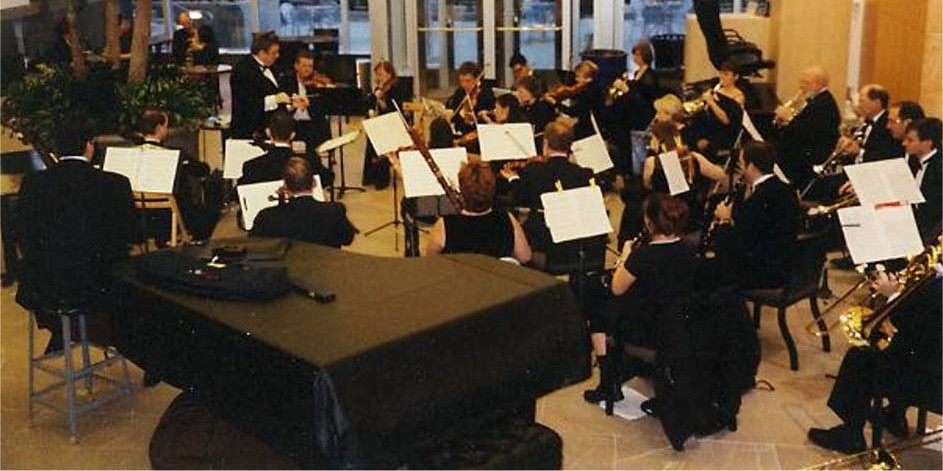
James: Yes. The formality comes from what you can do. It was maybe a couple of dozen people. It was always difficult to find a full set of horns or a full set of winds, that sort of thing. There was a single bassist that would come in for the concerts.
KCO: How did Kathy get involved?
James: I’d been at Microsoft since 1999. I came to the Seattle area to be at Microsoft; I was working for a start-up in the Bay Area which was acquired by Microsoft. I came up here in the role of a software tester. Kathy was looking for somewhere to play. She’d been playing violin and so she got involved. That’s how that happened.
KCO: That’s some good luck for us.
James: Yes, it was fortuitous. It was fun. And, like I said, I would help out in percussion on occasion but not regularly. It was a Ballard Locks concert as I recall, where we where we were playing some marches and pop music. And so, I said, I’ll be glad to come and do this. Then he decided that he would not be able to continue.
KCO: Was he an employee as well?
James: Yes, he was an employee. If your employer is Microsoft, you’re generally going to focus on the job at Microsoft. In my mind, I was always a musician. My focus was not so much on Microsoft as it was on having the time to express myself, musically. That’s why I was more invested in it. It was another outlet for me to express myself musically and try to do something with an entire category that I hadn’t ever done before. When I was a church choir director, I hired an orchestra for a service. Or a brass ensemble for a service. It wasn’t a regular type of conducting that I did, so I wanted to see if I could. I wanted the challenge of seeing if I could do that.
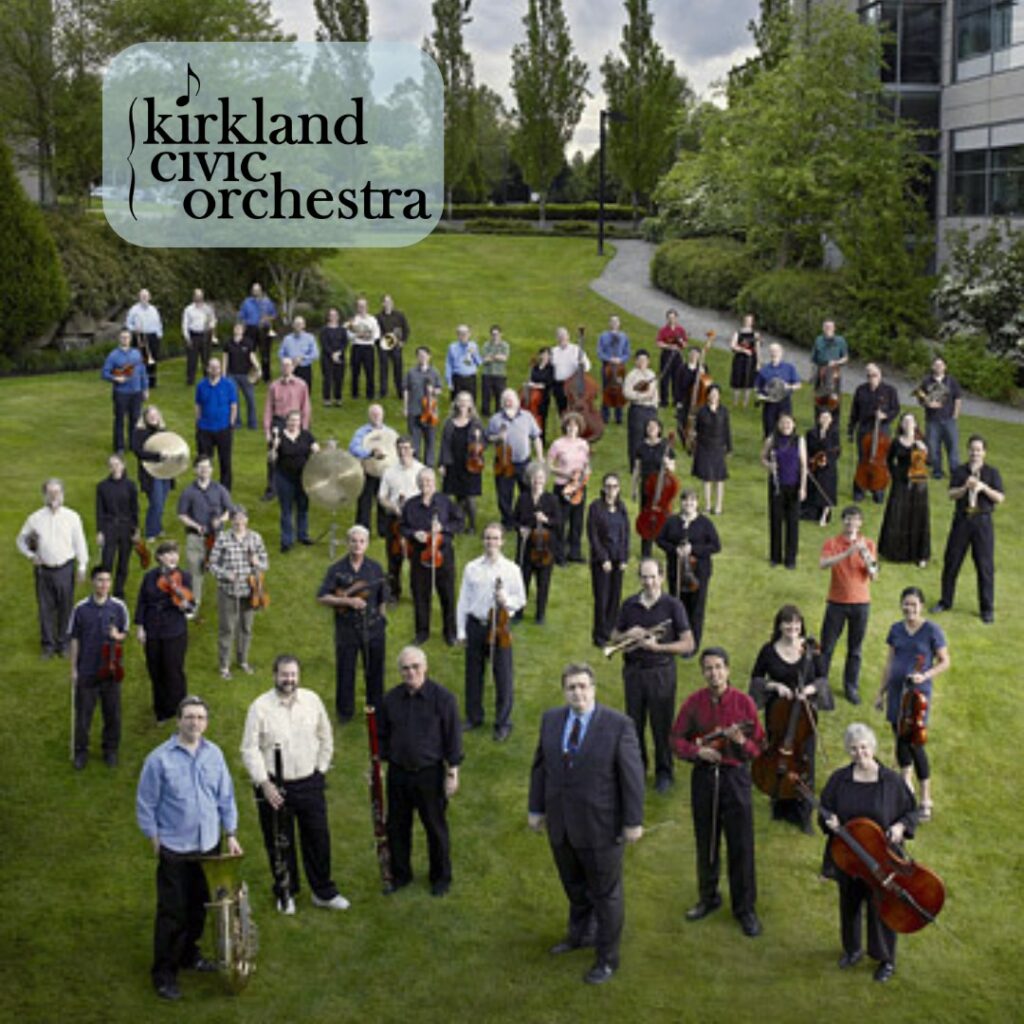
KCO: I know when I came in, there was another tuba player. I just hadn’t had that experience of a tuba section in an orchestra, and that gave me a kind of impression of we’re a little more open minded. I observed, a lot of things weren’t as I’d experienced them before. But since then, you have always been my conductor. I’ve only experienced this group as your vision. When did that start to take shape?
James: At the very beginning. The very first season I start conducting. It must have been the fall of 2003. Something like that.
I’m bad with dates so I could be off.
From the very beginning because, from my perspective, I want to make music. If I need another bassoon player, I’m going to try to find another. I’m going to try to find all the parts that we need to do this piece of music. I prefer that to trying to struggle through and leaving a bunch of stuff out. Although, I can do that. And I have, but it’s not the best expression.
So, that’s the reason I started pushing the group to find more players, and to bring more people in and beef up the sound. To increase the size of all the sections and to make sure that we always had flutes and oboes and clarinets and bassoons and all the French horns to have all the parts. Then to start trying to attract as many string players as I possibly could.
Orchestra begins to change
KCO: By 2006, I joined the orchestra and have my own view of the changes. The orchestra grew a lot. The level of ability and what we could play substantially changed. By 2015, for me, the musical experience feels very different. We become the Kirkland Civic Orchestra. What drives the change from Microsoft affiliated orchestra to standalone Kirkland Civic Orchestra? While we were the Microsoft Orchestra, and we were progressing, but many of our concerts were in the cafeterias on the campus, not often in public spaces.
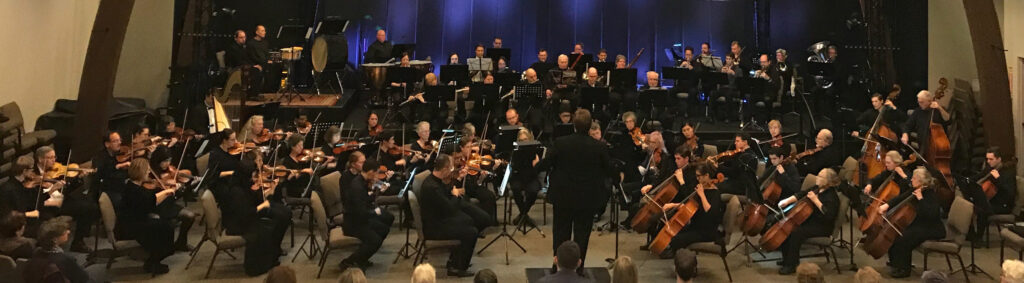
James: The main driver of all that was practicality. Microsoft changed a bunch of its interior spaces, essentially making them unavailable to the orchestra. Because of that, we couldn’t do what we did before. Up to that point, the orchestra wasn’t its own organization, but as soon as you need to go and find an external performance location or an external rehearsal location, you need to have insurance.
To have insurance, you need to be a corporation because an individual isn’t going to take on that burden. As soon as you need to be a corporation, that’s when you become more real. We were real before, but now you must have all of the things to support that.
Previously, I would buy a bunch of music and other people in the orchestra would buy pieces of music. We would prepare them and perform them in whatever site we had. But as soon as you need a place to rehearse outside of Microsoft, then you need to pay for that space. You need to pay for the insurance so you can get the space. It’s the same with the performance spaces. So, whenever you do that, you have to become real. Now you have to fund it.
KCO: This may be hearsay, I don’t know. You can clarify. I do remember when the spaces at Microsoft started changing. We just didn’t have the open space to use for rehearsing. I also remember doing a photo shoot outside of a cafeteria. Wasn’t this a recruiting tool for Microsoft? So those seemed to diminish at the same time: the amount of space and the role that the orchestra played for the company. Is that fair to say?
James: I think that there was a point in time when Microsoft could use the extracurricular activities available to the employees to entice new employees to join the compnay. But I think the the bigger driver was the practical nature of not having a place for rehearsing or playing.
KCO: The orchestra was used for recruitment, right?
James: It had been. I remember talking to people in HR about it and I did send an email to Bill Gates that they mentioned in that article. asked if he wanted to play because he played trombone as he grew up. I found that out and I said, hey, you know, we’ve got this group here on campus and if you’re ever interested in joining us, please feel free to drop in.
He’s a busy guy. Yes, he was very kind and, but I certainly didn’t want to exclude him. I kind of knew what the answer was going to be. It would have been a very surprising thing if he had been able to do that.
KCO: That would have been crazy.
James: It would have been. It would have been a big deal for sure.
KCO: Certainly, for a long time, you have joked at the Locks concert that a good portion of the group was Microsoft or Microsoft adjacent. And that has changed.
James: It has changed. My interest was building an organization that could perform interesting repertoire, which was beautiful and inspiring. And we could present it to an audience that would appreciate it and want to come. That was my desire, even when we were in the Microsoft orchestra.
That was what I wanted to do, to make beautiful music to inspire people and for them to hear us. When we hit that point where we could no longer use the Microsoft spaces, it was very clear that we had to turn that knob a little bit more. But even earlier I was trying to find players that would join us, and I was not as invested on making sure that they were only Microsoft employees. Because when I need two bassoons, I need two bassoons.
Microsoft can only provide whoever happens to work there. And also, it’s really hard for Microsoft employees to find time in their very busy schedules to be consistent. And yes, consistency is needed for improvement. So that’s the other reason why I didn’t want to limit the participation to Microsoft employees.
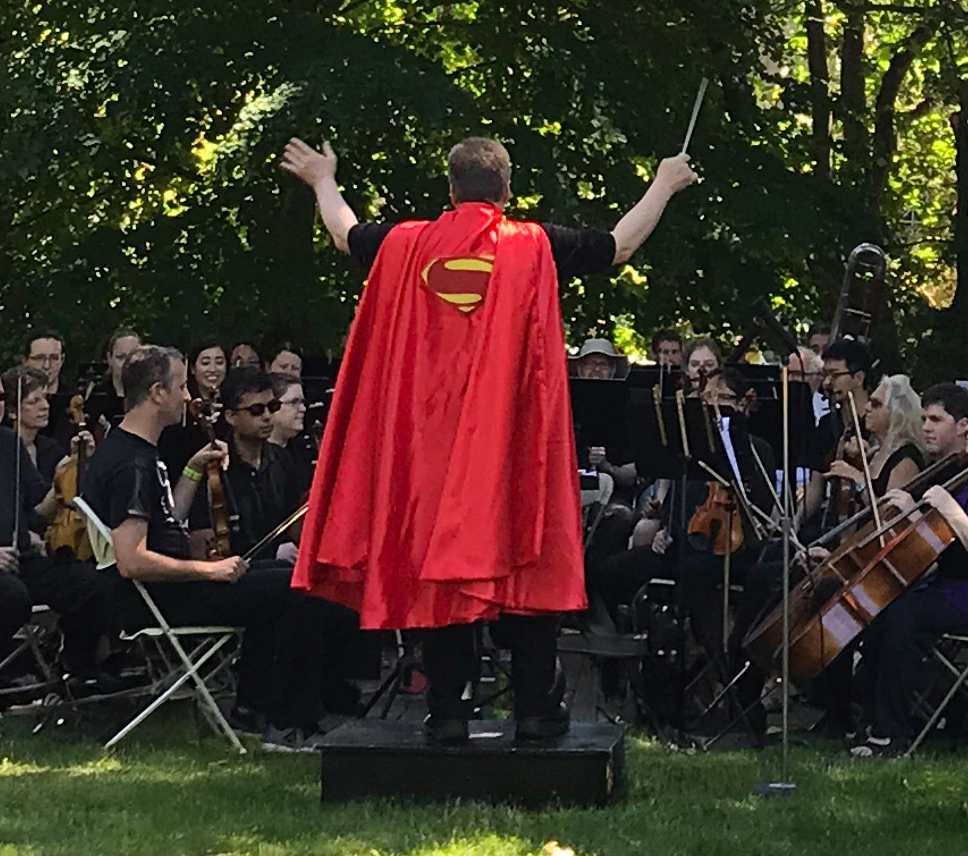
There were challenges, and change doesn’t happen overnight. It’s more important that we just continually raise the bar, just kind of constantly.
KCO: So, the orchestra changes 10 years ago, you turn it into the Kirkland Civic Orchestra.
James: Well, we did with the board. I mean, there’s a bunch of people that do that for sure.
What does a conductor do?
KCO: Now the orchestra is a standalone group, independent of Microsoft. I think there’s also been a steady progression of musicality.
I asked a couple of people to give me their questions, and I have a couple questions I want to ask that are a precursor to asking you why you’re stepping down. But, let me come back to that, just know that it is coming.
What does a conductor or music director do?
James: It varies. In some ways, we are the traffic cop; we’re just kind of making sure everybody plays together. I think the thing that the conductor does most is that he has a vision of what the music could sound like. From my perspective, it’s how I want it to sound. I have to worry about all the individual parts and the balance of all those individual parts. And make sure that as I’m conducting, and as we are rehearsing, that I’m tracking all of the mechanics of sound production.
So, I’m listening to things, making sure that we’re in tune, that we’ve got the right balance, that we’ve got the right rhythms and the right articulations. Normally that’s quite a bit. But there’s also a bunch of stuff that happens before you get there. I have to learn the score. I have to know what all the parts are. I have to know which parts are important and which are not important.
How does this section of the orchestra relate to another section of the orchestra? How do I balance that? The quandary of conducting is that you want to make sure that you are expressive enough and also clear enough so that you don’t have to talk so much. Because the more you talk, the less time you have to play music. That could be less interesting for the players, and it also takes longer.
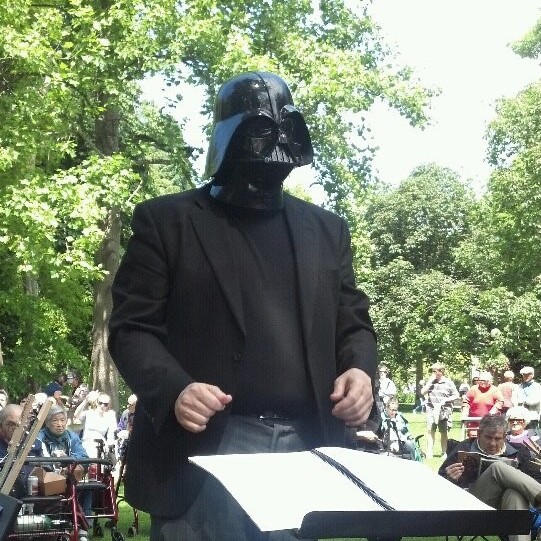
From my perspective, I want to try to do everything that I can with my gestures. So, whether it’s a strong thing or whether it’s a sharp thing or sharp as in pointed sound, rather than pitch, and then provide feedback to the orchestra in flight, about how things are going. I’m going to want less from one place or more from another, or I’ll point my point at my ear, where I’m hearing something that people need to be listening for. I’m hearing something. Do you hear something? It’s that sort of gesticulation and sometimes I’ll stop the orchestra and say, okay, we need to go back. Look at these following things and then try it again. It’s repetition that provides for that for that expression.
KCO: So that’s on the podium. What do you do off the podium?
First, I am choosing the pieces. Before I have even started looking at a score, I’ll be doing a lot of listening and listening to pieces that I’m not familiar with. Looking around for music which is topical no matter what the topic is. Looking for music that is about something. I’ll listen to that music if it is available, listen to multiple recordings of the same work. Listen to the same piece done with different interpretations done by different conductors.
By the time I get to program a year of concerts, the previous year was used in preparation. I’ll spend the year before figuring out what pieces I want to do. Where the challenge is going to be for the orchestra. How will the challenge express itself. Is it going to be rhythmic? Is it going to be melodic? Harmonic? Is it going to be technical? What kind of challenges am I generating for the players? Making sure that I’m clear. Some scores are complex, some scores have a lot of moving parts, some scores have a lot of stops and starts.
From a preparation perspective I need to know every one of those things and have a solid idea about what I want there. I’m not going to wait until I hear it, be perplexed, and then provide feedback. I want to avoid saying let’s try this and try that. That happens on occasion depending on how much time I’ve had to prepare. But, I’m generally well prepared ahead of time. That way, I can avoid wasting 65 people’s time. I’m figuring out what I want to do in advance.
I will do some a/b testing on occasion. I’ll have a couple ideas, try both of them and decide which one I want to do. I also include the feedback I get from the players. That feedback might make me adjust certain things in my conducting. It’s an immediate feedback loop. I’ll hear what’s going on in the orchestra and take immediate action about how I will either change my conducting style or even the grip of my baton. All of those things in the feedback loop, inform my choices.
Influence of conducting on musicianship
KCO: How has conducting, rehearsing, directing changed how you approach and prepare for being a musician in rehearsals, or has it?
James: It hasn’t for me. Normally, I put a conductor’s eye view on pretty much everything. I’m trying to do the same thing that I do as a conductor even though I’m in charge of one particular part. Normally, I’m going to be a percussionist. I’m going to make sure that I’m keeping the whole thing in my head while also keeping the specific part in my hand. I’m always listening to the whole thing and asking how do I fit into it? I try never being so insular that I don’t know what’s going on around me because I’m there to make music with other people.
KCO: You try to take as broad of view as a musician or player as you do as a conductor. Does it have any impact on how you enjoy music?
James: Yes, it certainly does because I will hear less accurate parts. I sometimes have trouble turning that part off. If it’s not well executed, I will sometimes have trouble looking at the whole picture because I will focus on that because that’s what I would do as a conductor. I would say, oh, that’s out of tune, I better pay attention to it. And try to get it back online. In a recording, you can’t really do that.
Notable moments
KCO: During your time as the conductor of the Kirkland orchestra, have there been any highs, lows, or memorable moments that you would want to share? I remember the bridge closure right before a concert. That was one for me.
James: I think that something I’m proud of, not necessarily for myself, but for the group, is the willingness to go out of their way to make music together.
The bridge incident that you’re talking about is one of those examples where people couldn’t get to the concert to perform, literally could not cross the bridge. We have people in Seattle and their distraught feelings because of missing the concert was very heartwarming for me. For that concert, there were individuals that sight-read a part because they could and because they very much wanted it to be a good thing. That makes me feel very proud of everybody who participates. It makes me feel really glad to be associated with all of the positive energy that is directed at the orchestra.
Personally, I’m enjoying all of our concerts. They are taxing. They are debilitating afterwards, but I enjoy them a lot. I enjoy making music with all of these friends that we have.
I think that we’ve risen to a number of challenges a number of years ago. We did Also Sprach Zarathustra, which was such a challenge. People rose to the occasions so magnificently. It wasn’t our best performance. But it was a magnificent performance for the challenges that we were attempting. It makes me very happy that people are willing to try and feel good about the music that they do.
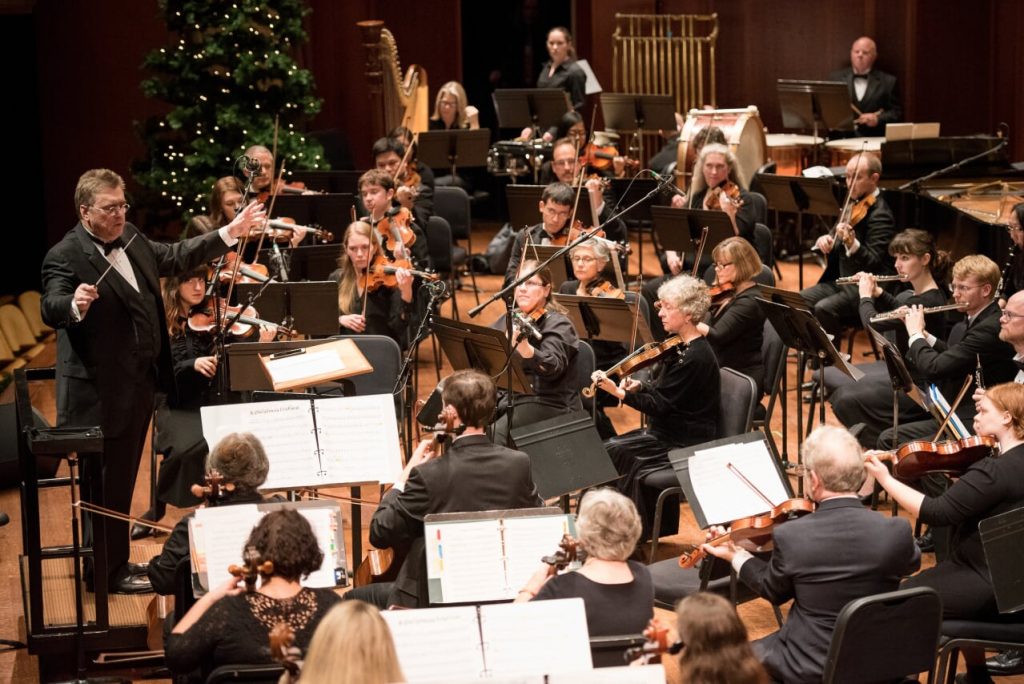
KCO: One of my favorites is the Rachmaninoff Isle of the Dead.
James: Yes! One of my approaches to programming is to program pieces of music that are generally not performed, that are not the top 10. I think that there is so much beautiful music and people get a little bit narrow in their focus. One of the things that I tried very hard to do every season is that I would try to break out of that. That’s the reason I program things like the Vaughan Williams, which is not commonly performed. The Magnard we’ve played is another of these outlying pieces that you generally wouldn’t hear in a concert hall. But you’ll hear them if you come to our concert. This season is my recap.
KCO: Yes, it’s like your Greatest Hits.
James: It’s some of the things that I absolutely love and some of the things that we’ve performed really, really well and can perform again. I think we could do that more often. We all grow as individuals and going back to a piece is a way that you can measure your growth. I think it’s important for people as individuals to understand that they’ve grown.
Stepping down – Next phase
KCO: Yes, 100% agree with you. Now the big question: Why are you stepping down? Why now?
James: There are multiple reasons. One, I’ve been doing this for 22 years and that is enough. Two, I think the next phase of growth for the orchestra needs to be from someone else with a different viewpoint, a different set of tools, and a different set of visions.
I think that organizations need new input. They need to be challenged in new ways. What we’re trying to do is to find another candidate who can do those things, who can challenge the group in new ways, and who can find new things in the group that the group didn’t know they had.
Leadership is very important. In my opinion leadership is important at two times. One time is at the beginning, when leadership lays out a vision, and say this is the path we want to take. And the second time where it’s super important is when that leader, a person, decides that they can’t make those changes anymore either because of habit or energy.
I have a certain set of skills that solve a certain set of problems. Somebody else has a different set of skills to solve different problems. I think that it’s important that the opportunity is given. I need to make sure that I don’t get in the way of that because I think that the next phase of the orchestra will be even better, but it can’t be me. It must be somebody with a new vision.
KCO: Because you were the pioneer and now you need the successor?
James: Well, I think I think it’s more like a pioneer and a new pioneer rather than a successor. It’s not a successor. It’s what vistas are now in front of us? Who’s the best person to find their way there? I have blind spots; everyone does. And I explored what I can explore.
There is an age aspect of it too. Right now, I am getting older, and it takes me longer to recover even from rehearsals and things like that. I need to make sure that there is new energy, new problem-solving skills, and a new vision. I need to make sure that the organization has opportunity. I don’t want to be in the way of that.
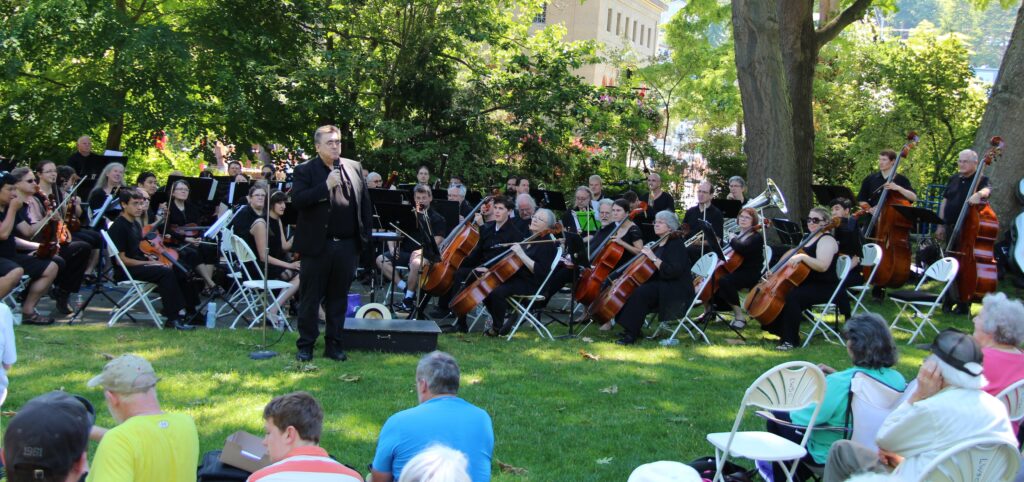
KCO: I am trying to figure out the way to say this. I don’t want you to think I’m saying that it’s time for you to go. That’s why I’m trying to carefully choose my words. I very much appreciate all the work you did to get us to this point. I think that the next person will inherit a hell of an opportunity.
James: Well, that’s my hope. That what I have built, what we built together, is something to be proud of. It expresses itself as a musical vision and has a point of view that’s unique and meaningful. And the next person, I want them to have an opportunity to work with what we’ve built and see where it can go.
KCO: I think I understand the vision that you’re laying out and I understand the curation that you’ve done to get it to here. Now, it’s handed off to somebody else to see what they can do with it. And that could be really cool.
James: Absolutely. There’s definitely a physical aspect of this role. That is starting to show on me. I know that, and I don’t want to be too long in this position where it’s just not good anymore. What you really want to do most the time is to go out at the top of the curve. This season has been pretty spectacular and feels pretty top of the curve to me.
I’m really pleased that we’ve built something so wonderful that the next person can take and grow.
KCO: Is there anything you want to say to the orchestra?
James: I’m so grateful that I’ve had this opportunity and so grateful that I’ve been able to grow with the orchestra because I’ve done a lot of growing, too. I’m grateful that I’ve had that opportunity, and it makes me very proud of the things that we’ve accomplished together. I couldn’t be happier about where we are today.
KCO: Perfect. Thank you, Jim.
Thanks to Jim for the interview on 22 April, 2025.
by Francis X. Langlois – tuba player in the KCO
