- Musical start
- Becoming a music major
- After graduation
- Profession of music
- Early music
- <Intermission>
KCO: The KCO is celebrating its 10-year anniversary. At the same time, you decided that 2025 would be your last year as conductor and music director. Before we talk about that, let’s first step back and talk about your musical Journey.
Musical start
When did you get into music in your early life?
James: I started taking piano lessons in 1970. I would have been 13 or 14, but the lessons didn’t impact me significantly. It just was a good thing to do, a way to learn music. I wasn’t invested in it or interested in pursuing it seriously. Although I did enjoy it very much, and I kept taking lessons until I was a sophomore in high school. But I wasn’t doing any music. I didn’t really do very much music in high school until my senior year when my sister made me join the choir.
KCO: Where was all this happening?
James: My family moved to New Jersey in 1970. My first piano lessons were in New Jersey We moved back to Southern California, to a town called La Cañada, in 1971, I think. We moved to New Jersey in 1969 and then moved back to California in 1971 or thereabouts.
KCO: Not long in New Jersey?
James: It was just a two-year assignment for my father who was working for AT&T.
KCO: Your sister “made” you join the choir?
James: Yes. Basically, she said you’re going to go do this.
KCO: Is she your older sister?
James: No. She’s my younger sister.
I have three younger sisters. She insisted that I try to do this.
KCO: Why did she do that? What was the impetus for her?
James: Well, I could sing, and I did sing in the houseand stuff like that. I can carry a tune, and make a reasonable sound, and she thought I should go do that.
But I had other things I was doing. I was more interested in math and science. I was spending more time on that. And girls.
KCO: So, you join the choir and what happens?
James: I had some talent, and I was involved in musical theater as well. I had friends who were in band. So, the director, I think, suggested that I participate in The Music Man, which was the musical they were doing that year. I was one of the guys in the barbershop quartet. I have a high voice. It was fun! It was fun to have friends there and hang out.
When I graduated from high school, I was already interested in going to college. I wanted to be a high school physics teacher. I started taking all the science and math classes. I went to Pasadena City College and while I was there, I sang in the select ensemble called Chamber Singers that they had. But I was mostly studying the math and science path. I went into my third year, and I decided that this music thing is really interesting. I liked the music classes more than physics because I could have a solution for a piece of music. Then later, I could come back to that same piece of music, and because I had changed, I could express it differently.
That’s not something generally that you wind up doing very often in math and science. It’s possible can but it generally doesn’t work that way. If you solve something, then you find something new to solve. And I appreciated the fact that I could actually work on something and achieve a goal. And then, I could go back to that a year later and it was now a different thing. I enjoyed that aspect of making music.
The learning part and applying new tools that I’ve learned to the same problems. Or, my understanding of the music might have changed. Because I had more experience, I could bring a different expression to the work. I appreciated that more.
I also wound up being the assistant conductor in the chamber singing group. So that was another aspect of something that I enjoyed, which was inspiring other people to make music with me. And to help lead an artistic vision for a piece. That was probably 1978.
I decided I would change my major. I was preparing to transfer to a four-year university and so I took another year to catch up on all the music courses that I needed to take so that I could transfer in as a junior to the local four-year university.
KCO: That would be a lot of courses!
Becoming a music major
James: It was. And I took summer classes too. Normally, when I find something, I dive into it.
I enjoy the challenge of learning and that was one of the things that I enjoyed. So, I had a lot of course work and history to make up. I had music theory that I needed to catch up on. So, I did a whole bunch of extra stuff to examine.
KCO: About the only place I imagine you would have had an advantage was sight-singing.
James: Yes, and I was good at that too. It was something that I had a facility with that, and that made it easier for me to write music.
KCO: The first two years of music school are pretty much the same for everybody. You don’t even have a lot of flexibility in a conservatory-style place. So, yes, you would have to get through that same effort, which would not be easy.
James: Fortunately, I had the ability, and at Pasadena City College, you could find all these courses. The other place where I needed to work a lot was on repertoire. Because I didn’t have any historical knowledge. I wasn’t a big classical music listener. So, I had to dive into listening to classical music all the time.
KCO: In a music degree, there are a lot of requirements in the first two years for all students, regardless of major, like music history. You have to do them. You had a fair amount of ground to make up.
Most people I’m interviewing are instrumentalists because they are the guest soloists with orchestra. Many share a common experiences when, at some point, they have the thought, “I’m a little bit better at this than the other people around me.” Or someone says something like that to them. There is a moment of realization, and they think about going to the next level. What was that for you?
 James: I think it was the first time I got into the advanced choir, select choir. The choir was less than 30 people. I was able to get into that group. That was one of the things. The other thing that happened was the year after I graduated high school. My sister was still in high school, and the choir teacher told her that I had some real talent. He said he would have put me in other groups if I had shown any interest or inclination to do anything. So, I heard through my sister after I graduated that I had something that was a little less common.
That was one of those pieces of evidence, where you think, oh, maybe there is something here. Maybe I need to explore it a little bit more deeply. By 1979 or 1980, I had started to audition and get positions and be hired to be a singer. Clearly, I had something to offer. I did studio work from 1982 to 1987 in Los Angeles. I was working, I did recordings for movies and some television. I s some records. I was a backup singer on a Michael Jackson album. I sang on a country music album. I did a lot of radio as featured soloist on the local radio station in Los Angeles. I had been auditioning for a lot of these things so I had some experiences that said, hey, I could really do this.
After Graduation
KCO: I know you end up with a music degree. Now how do you get from there to Orchestra conductor? Between that part of your life and joining the Microsoft Orchestra in 2004, what happens?
James: So, after two years in physics and one year and music at PCC, I transferred to Cal State Los Angeles. I wanted to be a good teacher that could teach more than just High School, I wanted to be sure that any position that I was in that I had a solid foundation in orchestral conducting.
As a musician, I noticed that there are good conductors and less good conductors. Ones you want to follow and others that you have difficulty in following. I wanted to be sure that I was clear. Because it reduces time. It accelerates learning. It does a whole lot of things that I think are important.
When I got into Cal State, I started taking all the orchestral conducting classes, and all the orchestral instrument classes. Because I wanted to have a good enough Foundation that I could conduct both a choir and an orchestra. If you don’t know the instruments, and if you don’t know the requirements that instrumentalists have, then you’re not going to be very effective.
So that’s the reason why I was training in both of those fields, both choral conducting and instrumental conducting. And any time that you are in a place where there’s a good choir or a sizable choir, you’re going to have instrumentalists. You don’t want to be the choir guy that kind of conducts orchestras. You just want to be a conductor. At least that’s what I wanted. I just wanted to be able to conduct and communicate well. So, from my perspective, if you reduce your capabilities, you are reducing your impact. I didn’t want to do that.
There is a period of time where I conducted Church choirs. From 1979 to 1992 I was conducting church choirs. Then we moved to the Bay Area, and I stopped working with choirs as much. Although that’s not true. I had a choir in Morgan Hill, the South Valley Corral. That got formed and I conducted that. I would also have to conduct instrumentalists as part of that.
Profession of music
KCO: And you were in you were out of school at this point and making a living?
James: Yeah, I was out of school by 1984. I was a teacher. I taught music at a private school in Los Angeles, starting in 1982 until 1987. And then in early 1987, I went to Orange County. There was a middle school that I started teaching at.
In late ’87, I was singing in a choir that I’d been hired to perform with. During one of the breaks, I was talking to another man in the choir. We were talking about what we did, and I said I was a music teacher. He said that he used to be a teacher, too.
He taught German medieval literature and decided that these computers were going to be a big thing. So, he migrated into a computer high-tech job. We started talking, and he said that he needed help. I asked what kind of things do you need? He needed help with very rudimentary jobs, which I think anybody who’s paying attention could have done.
The job was to take a floppy disk, stick it into a floppy disc reader, type a program that would tell you whether it was a good copy or not. And that was the gig! I said, “well, I can do that.”
One question that you always ask when you’re working as a musician is what does it pay? This new half-time job that paid as much as my teaching job.
In fact, it was a little tough getting the job. Even though the job was rudimentary, the HR manager didn’t want to hire me because I didn’t have any computer background.
I used computers as tools. I wrote my master’s thesis on a computer, and I kept my grades on computers and stuff like that. But I wasn’t in the high-tech business. For me then, a computer was a great hammer.
<laughter>
They hired me to do that job. It was not a difficult job and there was an opportunity to learn more broadly about what was going on. I was able to teach myself a bunch of stuff. They hired me full-time and, I kept being a working musician. I kept performing and I got through some good auditions.
At that point, it kind of boiled down to what do we want to do for our family? I had a three-year-old boy. If I’m going to be a musician, I’m going to be gone a lot. That’s not great. Maybe I should pivot a little bit and get into this high-tech business.
Since then, that’s been my career, but it wasn’t my vision initially. And internally, I still think of myself as a musician before I think of myself as a computer science person.
So, and because of that, that’s one of the reasons why I’ve been consistently busy as a musician, all through my high-tech career. When I moved into the Bay area, I started a chamber music trio because I also play a couple of different instruments. Because I had a high voice, a very high voice, I sang as it was called a countertenor which is essentially a male alto. And in the early 80s, there weren’t a lot which I think may have contributed to why I got as many jobs as I did.
Early music
I also learned to play the recorder, and I had some pretty good facility with it. And then later in life, in the late 80s and early 90s, I then had more income. So, I collected a number of instruments that I could actually beef up the things I was doing working in early music.
KCO: What kind of instruments?
James: I have 40 recorders. I have an entire family of crumhorns, and I have a family of cornamuse as well.
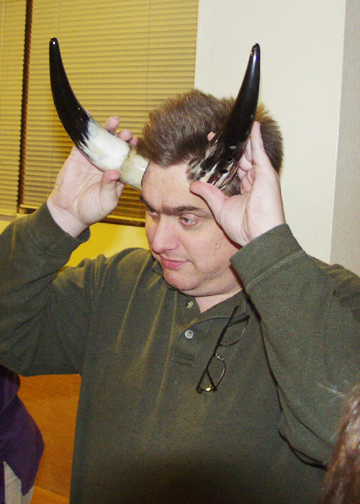
KCO: I don’t know what those are. Are these Baroque instruments?
James: Renaissance. I also have a set of gemshorn.
KCO: Again, I’m surprised, but I don’t know what they are.
James: They’re all early music, about the 1600s.
KCO: Are they reeds?
James: The crumhorn and the cornamuse are reed instruments and the gemshorn are fipple flutes. They are whistle types. The gemshorn term comes from the word “Gems,” which is an animal with a horn. You lop off the horn and then you can tune it and play it with holes like an ocarina.
It’s more of an ocarina sound. The cornamuse and the crumhorns are buzzy, buzzy. They are a capped double-reed instrument. You don’t actually put your lips on the on the reed, like you do with an oboe or a bassoon because the reed is capped. It has a much different buzzy sort of sound.
KCO: That’s really interesting, I can’t imagine you having a ton of gigs with these instruments.
James: No, no, I was far busier as a singer. But I did have gigs with the Gemshorns. We did do things with the with the reed instruments. I played a lot of recorder, too. They are not well known unless you are into early music.
<Jim shows me a picture on his phone>
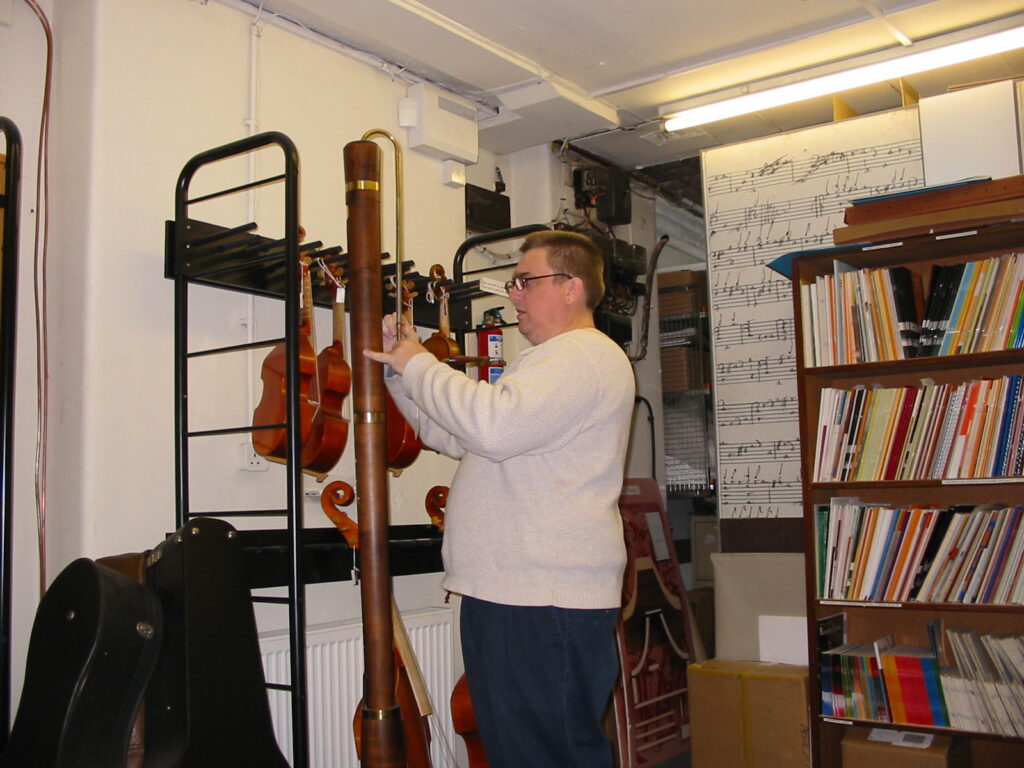
KCO: Okay, I see I see the similarity in the mouthpiece to the to the recorder.
James: Yes, that the double reed. That’s the cap of the double reed.
This was popular in courts throughout Europe in the 16th century, the Renaissance, and was made fashionable in the English Court by King Henry. The word crumb horn means bent.
<Jim plays me some music on his phone.>
KCO: It sounds like sort of like traditional music, folkloric music.
James: As I was studying music, I fell in love with this Medieval music and Renaissance music. I absolutely love the independence of the parts, the independence of the individual in it. You generally don’t have a crumhorn consort of 20 or 30, you’ve got one on a part. That is another thing that appealed to me because you are responsible for your thing. And if you don’t play your thing, that part is not going to be heard.
KCO: I know what you mean. In certain settings, you must have enough confidence and autonomy that you’ll be able to play your part on your own. Some people don’t have that much interest in it. Maybe there’s nervousness, anxiety, whatever. To me that’s another marker of people who understand where they fit in.
James: It’s the difference in my mind in an orchestra between a violin section and a flute player. The violin section, the strength in the sound that you’re looking for is that big section of strings that can play together. But the flute is an individual and has a highly individualistic role in the orchestra. It has usually highly individualistic music. Where were the pitches are going to be found.
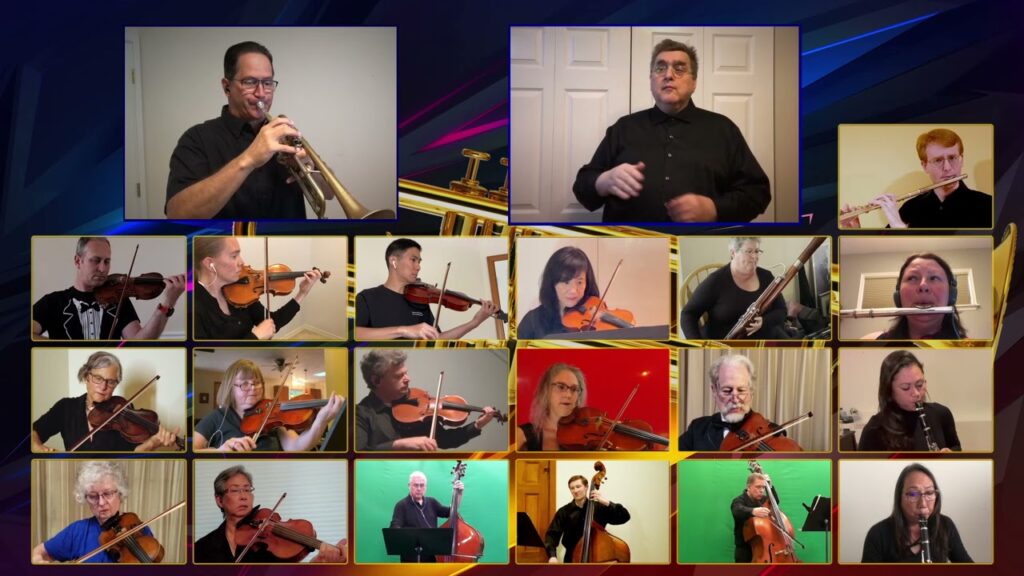
I’ve always been more interested in the individual. What does an individual contribute? How does that work? It’s one of the reasons why I’m not generally a big fan of huge choirs because of the homogeneity of the sound. The homogeneous nature of the sound doesn’t provide for the individuality that I’d like to hear.
When I switched to music, I was listening to music, and as I was catching up on all the listening that I needed to do, I found these recordings of early music that just lit me on fire. I thought that the music was so beautiful. The music is so intricate, and each person has their job, and each player has to do their job.
From my perspective, that’s what I loved and enjoyed expressing, I had some skill in it, and I could get the gigs that helped me do those sorts of things. So as a singer, I really, really enjoyed it. The things that I enjoyed were those one or two on a part, but mostly it’s that solo approach and the colors and the intricacy, the facility, how fast, and how flexible that group is.
<Intermission>
Thanks to Jim for the interview on 22 April, 2025.
by Francis X. Langlois – tuba player in the KCO
